



![The Higher Purpose - PART 2 [FIX THIS SITE BEFORE ADDING MORE ON IT] blog post cover image](https://sgp1.digitaloceanspaces.com/sc.academia/blog-images/oqclMA3OEzD1k6qYfQpsl0K8JXhNAaCHqrGTKMJZ.jpg)
General • 26 Sep 2025
The Higher Purpose - PART 2 [FIX THIS SITE BEFORE ADDING MORE ON IT]



General 22 Apr 2026
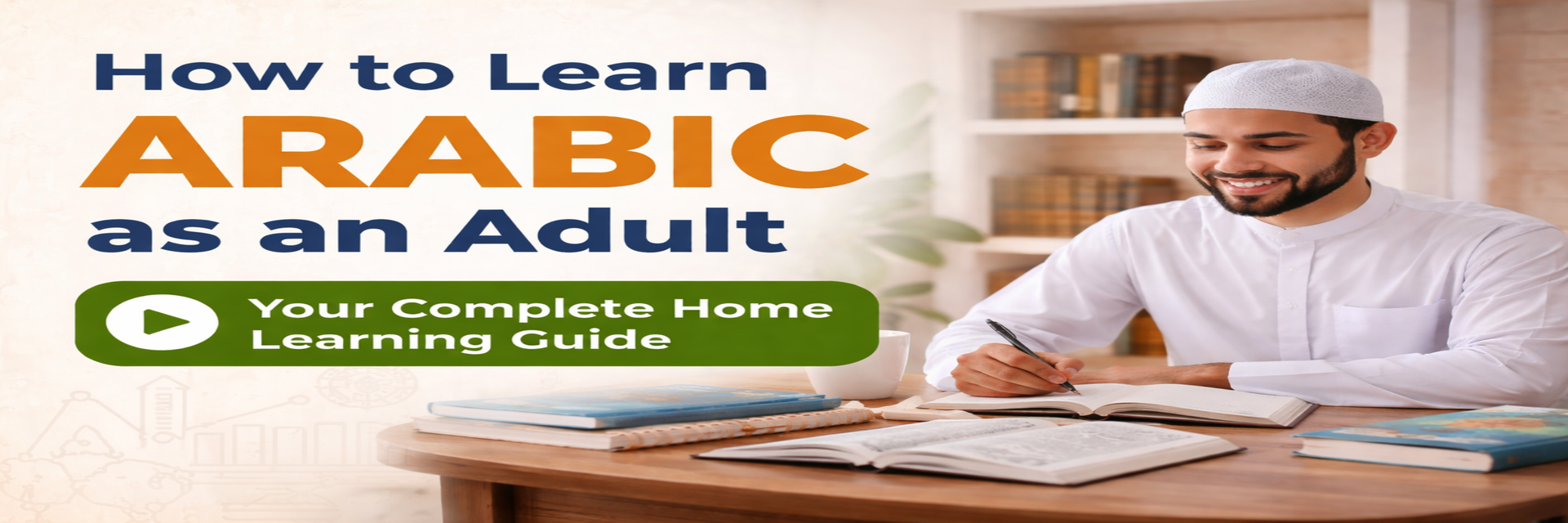
Learning Arabic as an adult feels like climbing a mountain—steep, challenging, but absolutely worth every step. If you're reading this, you've probably wondered: Can I really learn Arabic while juggling work, family, and life? The answer is a resounding yes.
Arabic connects you to over 400 million native speakers worldwide. Whether you're chasing a career opportunity in the Middle East, reconnecting with your heritage, or simply challenging yourself with something meaningful, learning Arabic is one of the best investments you can make in yourself.
Here's the reality: Adult learners have advantages that kids don't. You have discipline, purpose, and the ability to learn strategically. What you might lack is the right roadmap. That's exactly what this guide provides.
The challenge? Arabic's unique script, complex grammar, and regional variations can feel overwhelming. But with the right approach, consistent effort, and practical resources, you'll be having conversations in Arabic within months, not years.
Let's get started. Start Your Arabic Learning Journey: Arabic for Adults Course
Think about the global landscape. Arabic is the official language of 26 countries. It's the language of international diplomacy, Islamic scholarship, vibrant media industries, and booming economies. Learning Arabic isn't just about communication—it's about accessing cultures, opportunities, and perspectives that shape our world.
Arabic emerged in the Arabian Peninsula over 1,500 years ago. What started as a regional language became a global force through Islamic scholarship, trade routes, and cultural influence. Today, Arabic literature, poetry, and philosophy remain foundational to world civilization.
Fun fact: Modern Standard Arabic (MSA) was formally standardized in the 9th century—making it one of the most stable languages in the world. Your learning isn't chasing a moving target; it's tapping into centuries of linguistic consistency.
This is the question every beginner asks. Let's break it down:
Best for: Building a strong foundation, reading literature, understanding media
Best for: Making friends, understanding local culture, authentic experiences
Our recommendation: Start with MSA to build grammar fundamentals and vocabulary. As you progress (around month 3-4), gradually introduce colloquial elements based on your interests or travel plans. Think of MSA as your foundation and dialects as regional variations on top of it.
Here's the uncomfortable truth: 90% of language learners quit within three months. Not because they're incapable, but because they set vague goals and lose motivation when progress feels slow.
You won't be in that 90%. Here's why.
Get Enroll Now : Arabic Language Course for Adults
Motivation isn't one-size-fits-all. Before you learn a single word, answer this honestly:
Your "why" becomes your anchor when learning gets tough. Write it down. Revisit it monthly.
Forget "become fluent." It's too vague. Instead, use this framework:
✓ Master the Arabic alphabet and basic letter combinations
✓ Learn 500 everyday vocabulary words
✓ Understand simple conversations (greetings, introductions, basic questions)
✓ Read short, simple sentences
✓ Introduce yourself confidently in Arabic
✓ Expand vocabulary to 1,500 words
✓ Hold 5-10 minute conversations with native speakers
✓ Read children's books and simple news articles
✓ Write basic emails and messages
✓ Watch Arabic TV shows with subtitles and understand 60-70% of content
✓ Achieve conversational fluency in everyday situations
✓ Build vocabulary to 3,000+ words
✓ Read books, articles, and social media in Arabic
✓ Watch Arabic content without subtitles
✓ Plan a trip and navigate independently in Arabic
✓ Engage in complex conversations about current events, culture, and philosophy
✓ Read literary works and understand cultural nuances
✓ Write professionally in Arabic
✓ Potentially achieve formal proficiency certifications (ACTFL, DALF)
This is crucial. Your brain needs to see progress, especially when motivation dips.
Pro tip: Create a visible progress chart. Seeing your advancement builds momentum
We offer an Arabic for Adults online course specifically designed for independent learners who want professional structure without the commitment of traditional classes.
Structured Progression Rather than wondering "What should I learn next?" you follow a proven curriculum:
Phonetic foundations → Script mastery → Vocabulary foundations → Grammar fundamentals → Practical conversations
Expert Guidance Our instructors bring years of experience teaching non-native adults—they know exactly where learners struggle and how to help.
Accountability Many self-study learners plateau at month 3-4. Our course provides:
Practical Focus We don't teach abstract grammar rules. Every lesson connects to:
Community Study with other adult learners, share challenges, celebrate victories together.
Best timing:
How to combine:
Expected results from combining our course with consistent self-study:
Learning Arabic as an adult is one of the most rewarding challenges you can undertake. It's not easy. But it's absolutely doable, and the rewards—cultural connection, career opportunities, personal growth, meaningful relationships—are profound.
The only missing ingredient is action.
You can too.
Let's get started. Start Your Arabic Learning Journey: Arabic for Adults Course
If you're serious about learning Arabic systematically with expert guidance, professional structure, and a supportive community, explore our Arabic for Adults course. We've designed it specifically for independent learners like you—structured enough to guide your progress, flexible enough to fit your life.
Start Your Arabic Learning Journey: Arabic for Adults Course
Our course includes:
Combined with the self-study resources in this guide, you have everything needed to reach conversational fluency.
A: Conversational fluency typically takes 6-12 months of consistent (30-60 min daily) practice. Near-native proficiency takes 2-3 years. This varies based on your dedication and whether you get tutoring support.
A: Start with Modern Standard Arabic (MSA) for universal understanding. After 3-4 months, add a dialect based on your interests. Egyptian and Levantine are most commonly learned by non-natives.
A: No. Immersion at home (movies, communities, tutors) works. Living abroad accelerates learning but isn't necessary.
A: Self-study alone: $50-150/month (apps, books, occasional tutor). Our Arabic for Adults course offers structured learning at a fraction of traditional class costs.
A: Absolutely. Every fluent Arabic speaker started as a beginner. If you're reading this, you have the prerequisites (motivation, time, access to resources).
A: Language learning isn't a talent; it's a skill. Anyone can develop it with appropriate methods and persistence.
![The Higher Purpose! (Part 1) Uncensored! [FIX THIS SITE BEFORE ADDING MORE ON IT] blog post cover image](https://sgp1.digitaloceanspaces.com/sc.academia/blog-images/SFOjn6I8pTNBU7bKDHgVJndznkWqc2tBKodxYo1l.jpg)
